
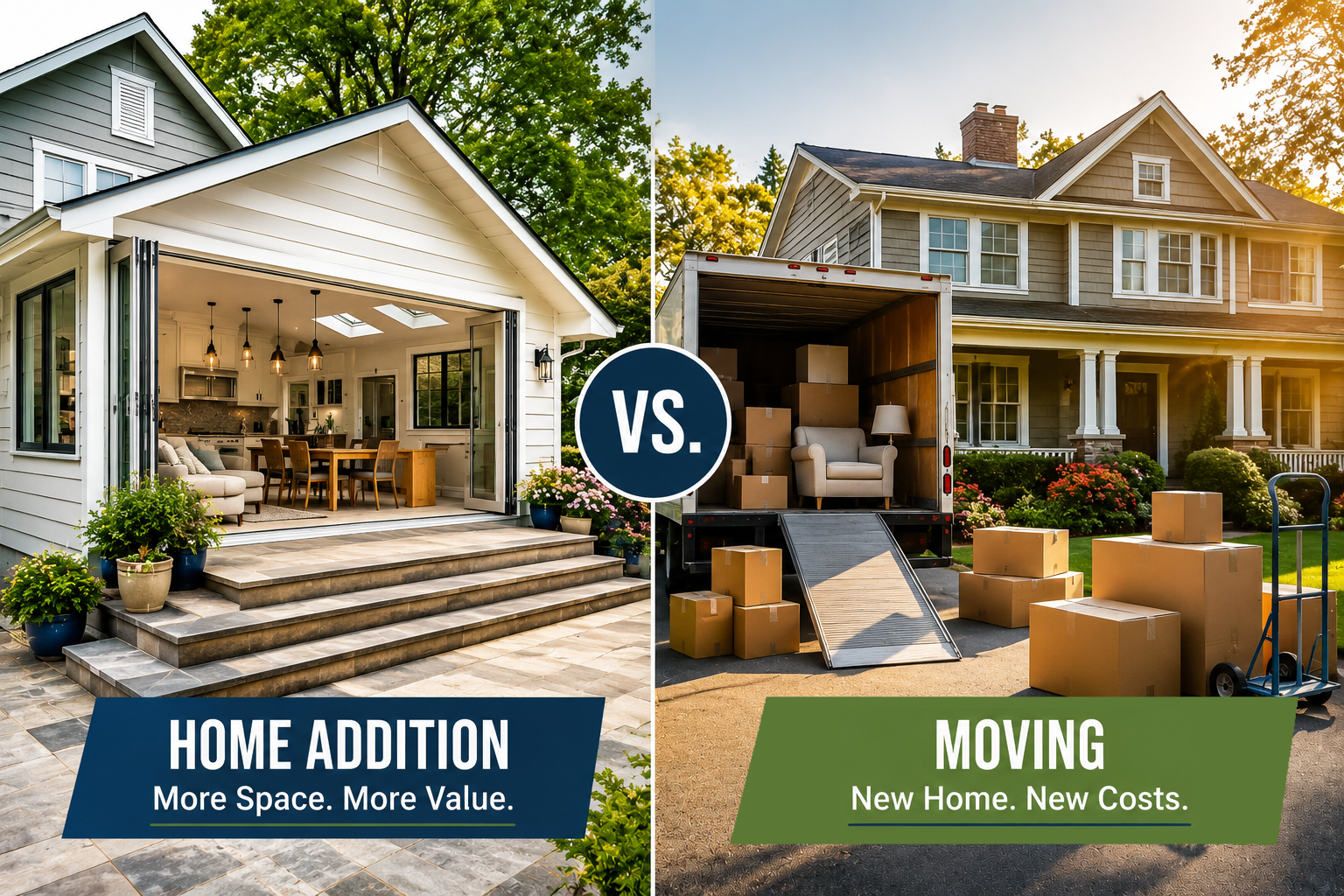
Home Addition vs. Moving: Which Option Makes More Financial Sense?
At some point, many homeowners reach the same conclusion: their current home no longer fits their needs. Maybe the family has grown, remote work demands a dedicated office, or aging parents are moving in. When that happens, two options usually come to mind move to a bigger home or add space to the one you already have.
Both choices come with significant financial and lifestyle implications. This guide breaks down the real costs, benefits, and trade-offs of each option to help you decide which makes more sense for your situation.
Current Housing Market Realities
The decision to move or expand can’t be made in a vacuum, it depends heavily on the current housing market.
In many parts of Massachusetts, home inventory remains limited, and competitive pricing means buyers often pay a premium for homes that already check every box. Interest rates also play a major role: homeowners with a low fixed-rate mortgage from previous years may face significantly higher monthly payments if they sell and buy at today’s rates, even for a similarly priced home.
On the other hand, home values in many Massachusetts communities have appreciated steadily, meaning homeowners often have substantial equity available equity that can be used to finance a home addition through a renovation loan or home equity line of credit.
These market dynamics are a major reason why home additions have become an increasingly popular alternative to moving in recent years.
Cost Comparison
- Costs of moving typically include real estate agent commissions, closing costs on both the sale and purchase, moving expenses, possible updates to the new home, and a new mortgage that may come with a different interest rate than your current loan.
- That is where the real comparison starts. Moving is not just about buying another house. You may also be paying to sell your current one, pack everything, transport your belongings, handle repairs, and adjust to a new monthly payment.
- Costs of a home addition vary widely based on the size and scope of the project. A modest addition, such as a single room or small bump-out, will usually cost less than a larger family room, second-story addition, in-law suite, or primary suite expansion.
- The final cost depends on the design, materials, foundation work, utility updates, permits, and how the new space connects to the existing home. Some additions are fairly simple. Others require major structural work, plumbing, electrical, HVAC changes or custom finishes.
While a home addition can still be a serious investment, it may be more practical than selling, buying, and moving. This is especially true if you like your current location, have a favorable mortgage rate, or only need more space to make the home work better for your family.
Lifestyle Considerations
Beyond the numbers, lifestyle factors often weigh heavily in this decision.
Staying put means keeping your existing neighborhood, school district, commute, and community connections. For families with children in school or those who’ve built strong local relationships, this can be a major advantage.
Living through construction, however, is a real consideration. Depending on the scope of the addition, you may need to manage noise, dust, and temporary disruptions to your daily routine though many additions are designed to minimize impact on the existing living space.
Moving offers a fresh start and the ability to find a home that already has the features you want, without the disruption of construction. However, it also means adjusting to a new commute, new schools, and a new community changes that can be significant for some families and minimal for others.
ROI Analysis
Not all additions are created equal when it comes to return on investment, and it’s worth understanding the difference between resale value and personal value.
Generally, additions that increase usable living space, particularly bedrooms, bathrooms, and kitchen expansions tend to offer the strongest return because they directly address what buyers are searching for.
That said, ROI shouldn’t be the only consideration. If you plan to stay in your home for many years, the value you get from improved functionality and comfort may outweigh a purely financial calculation. A well-planned addition that fits seamlessly with your home’s existing style can also help maintain or improve your home’s marketability down the road, even if it isn’t the primary motivation.
Popular Addition Types
Some of the most common home additions homeowners pursue include:
Second-story additions Adding a full second floor over an existing single-storey home is often used to add multiple bedrooms and bathrooms without expanding the home’s footprint.
Primary suite additions Expanding to include a larger bedroom, walk-in closet, and en-suite bathroom, often a top priority for growing families.
In-law suites or accessory dwelling units (ADUs) Increasingly popular for multigenerational living, these additions typically include a bedroom, bathroom, small kitchen or kitchenette, and separate living area.
Kitchen and family room expansions Pushing out the back of a home to create larger, more open living spaces, often combined with updated kitchens.
Sunrooms and three-season rooms A more budget-friendly way to add living space, particularly popular for homeowners who want more connection to outdoor views without a full addition.
When Moving Makes Sense
Moving may be the better option when:
- Your current lot size or zoning restrictions don’t allow for the addition you want
- The cost of an addition would exceed the value it adds, making the home “over-improved” for the neighborhood
- You need to relocate for work, schools, or other lifestyle reasons unrelated to the home itself
- Your current home has structural or location issues (like proximity to a busy road or lack of outdoor space) that an addition can’t solve
When Adding Space Makes Sense
A home addition often makes more sense when:
- You love your neighborhood, school district, and location.
- You have a favorable mortgage rate you don’t want to give up.
- Your lot has room for expansion, and local zoning allows it.
- The cost of the addition is reasonable relative to your home’s value and the broader neighborhood.
- You need specific space (like an in-law suite or home office) that’s hard to find in existing homes on the market.
Deciding between a home addition and moving ultimately comes down to your specific finances, your home’s potential, and how you envision your life in the years ahead. Both paths can make sense it just depends on your goals, your property, and your local market.
Rands Construction LLC works with homeowners throughout the region to evaluate addition options, from initial feasibility through design and construction. If you’re weighing whether to expand your current home or move, our team can help you understand what’s possible on your property and what it might cost, giving you the information you need to make the right decision for your family.